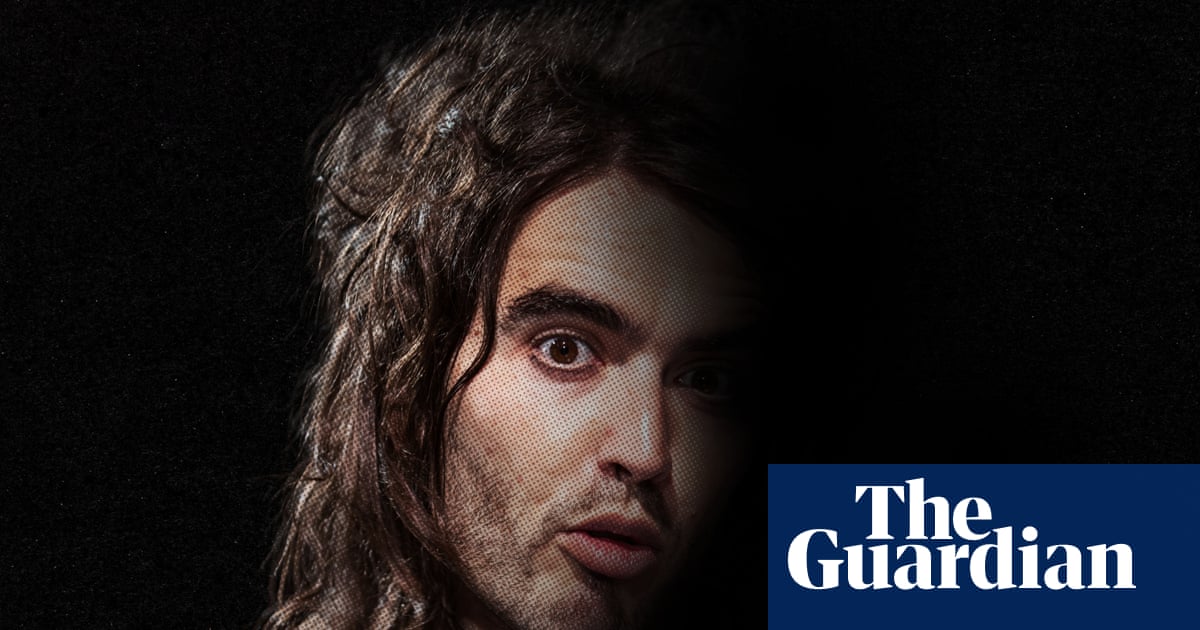
Russell Brand’s case has led to difficult questions for the BBC, Channel 4 and the production companies that worked with him. Composite: Guardian DesignView image in fullscreenRussell Brand’s case has led to difficult questions for the BBC, Channel 4 and the production companies that worked with him. Composite: Guardian DesignMisogyny and sexism of Russell Brand case have not gone away, TV insiders sayConcerns remain that media industry is still failing to confront troubling behaviour
The downfall of Russell Brand: from Big Brother and Hollywood to convicted rapist
Even within the culture of casual misogyny and sexism that pervaded the TV world in the mid-noughties, Naomi Harvey and her colleagues concluded they needed to do something about Russell Brand.
Harvey was one of a team of researchers tasked with finding fans of Big Brother, Channel 4’s reality TV juggernaut, to appear on the discussion show Big Brother’s Big Mouth, hosted by Brand.
They had noticed Brand’s habit of asking a runner, the most junior person on the production, to obtain the phone numbers of female audience members and pass them to him. But something new had just happened. A distraught audience member had phoned Harvey to complain after being invited for drinks by Brand after the show.
“All I remember is being really taken aback that she was so upset,” Harvey recalled. “We noticed this behaviour of taking women’s numbers, and now it had escalated to the point that we’d had a member of the public phone up the desk upset.
“We felt as the audience team we had a responsibility, so me and my two colleagues reported it up to our next boss.
The episode is minor when set against the criminality exposed during Brand’s trial. Yet it is part of a culture that appeared to indulge Brand and fail to confront troubling behaviour.
Brand’s case has led to difficult questions for the BBC, Channel 4 and the production companies that worked with him. The TV world is again asking itself whether recent efforts to improve safeguarding will stop similar abuses.
There were several moments during Brand’s trial in which the TV culture that had tolerated his behaviour for so long seemed to be alongside him in the dock.
One of Brand’s accusers explained why she had not come forward with her experience earlier. “The media industry protects its own,” she told the court. Another woman, an ex-MTV employee, said she did not report an incident at the time because she was scared. Brand was famous “and a big asset” to the channel.
Rumours about Brand’s inappropriate behaviour were circulating within the standup comedy circuit before he ever reached TV screens. Even so, serious allegations about Brand didn’t emerge until 2023 after a joint investigation by Channel 4’s Dispatches and the Sunday Times.
England’s strict defamation laws played a part.
“We have these ‘open secrets’ where everybody just knows this thing is true,” said Charlie Moloney, the co-author of McNae’s Essential Law for Journalists. “But of course, when you start to imagine how that would go if it were ever cross-examined in a court case, some of these open secrets fall apart under that level of scrutiny.
“Someone says: ‘Alright, well if everybody knows this, can you actually prove that it happened?’ At that point, you’ve got a lot of work to do.”
View image in fullscreenRussell Brand on stage at the 2008 MTV video music awards in Los Angeles. Photograph: Jeff Kravitz/FilmMagic.comRed flags were not hard to find, even among Brand’s public utterances. While on BBC Radio 2 in 2008, Brand laughed on air about exposing himself moments earlier to a woman who was working in the same building in Los Angeles.
He also directed sexualised humour at a newsreader during his Radio 2 show, saying he wanted to “unleash hell” on her thighs, and appeared to make light of requests from production staff to apologise. During a 2007 interview with Jimmy Savile, he joked about sending a female assistant to him naked.
Brand eventually left the BBC after “Sachsgate”, when he and Jonathan Ross left obscene messages on the answerphone of the actor Andrew Sachs.
The BBC, Channel 4 and Banijay UK, the owner of the production company behind shows including Big Brother’s Big Mouth, all conducted reports into their handling of concerns about Brand.
Banijay’s report found no formal complaints were made about Brand, but complaints made informally – including some about him asking runners to obtain phone numbers of audience members – were “not properly escalated or adequately addressed”.
The BBC apologised after its review found there were people who had concerns about Brand’s behaviour, but believed he “would always get his own way” and stayed silent. The Channel 4 review found a complaint was not escalated to its senior management team. All said they had improved safeguarding and whistleblowing efforts.
View image in fullscreenRussell Brand on Big Brother’s Big Mouth in June 2006. Photograph: Rex/ShutterstockSenior figures from the era freely accept the culture needs to change.
“Bad behaviour towards women was tolerated in television for too long,” said Alex Mahon, the former Channel 4 executive who ordered the Brand report.
“People don’t stay silent because they don’t know it’s wrong. They stay silent because they don’t trust what happens if they speak. It’s improving … but more than half of people who experience bullying or harassment in the industry still don’t report it. And in other industries it is still rife. We’re not finished.”
There have been sincere attempts to promote whistleblowing and address the power imbalances in the TV industry that stop complaints being raised. A long-awaited online portal that allows workers across the UK’s creative industries to report harassment and abuse concerns has finally launched.
However, many TV insiders still say the Brand case cannot simply be written off as a problem of a bygone era of lads’ mags and raucous reality TV.
One insider said: “The rule of TV is and will always be: say nothing, don’t rock the boat and take whatever a celeb does without complaint as nothing will ever be done (and you’ll probably be branded a troublemaker and get blackballed).”
Harvey believed there was a greater willingness among broadcasters to listen to staff raising concerns, but worried that the same power imbalances and fear of being seen as a troublemaker persisted.
“A lot of the time, people don’t speak up because they’re worried about losing their jobs,” she said. “But also, they don’t think anything’s going to change because it’s easier to get rid of you, as a freelancer.”
Fox Style News Syndicate. Sourced from broadcast reporting: Read Full Source Coverage.