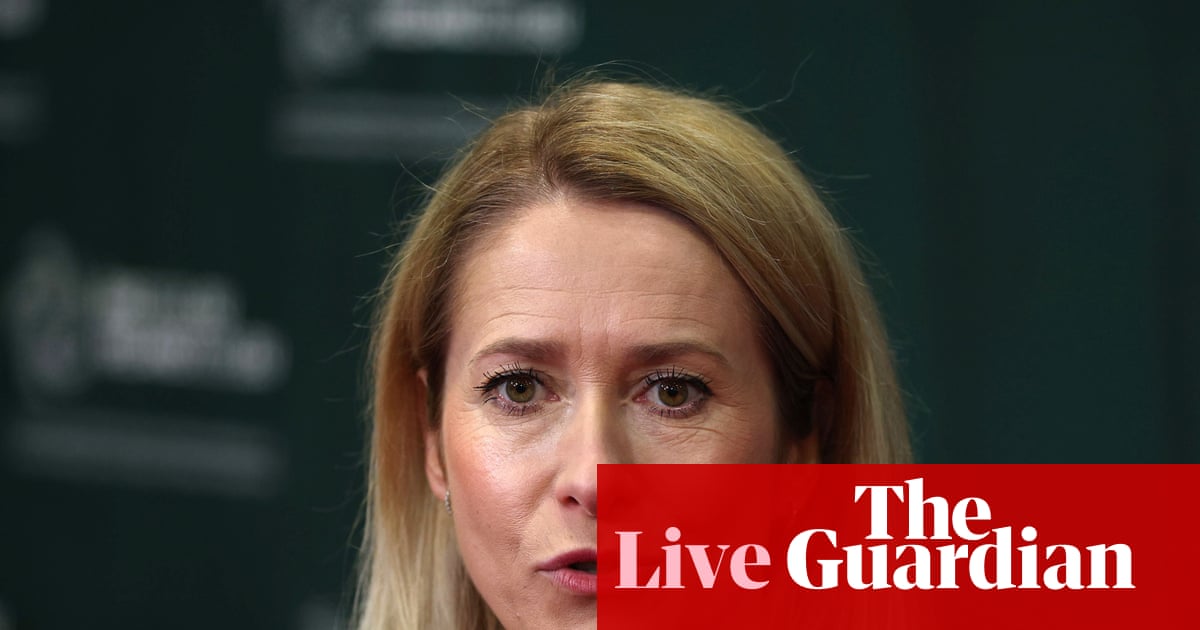
Kaja Kallas speaks to the media Photograph: Liam McBurney/PAView image in fullscreenKaja Kallas speaks to the media Photograph: Liam McBurney/PAFrom 2h agoMeanwhile, German tabloid Bild has reported on what it says are the key Russian demands put forward in negotiations with Europe, Ukraine, the US.
Russia’s president Vladimir Putin meets with US envoys, president Donald Trump’s son-in-law Jared Kushner and businessman Steve Witkoff at the Kremlin in Moscow. Photograph: Vyacheslav Prokofyev/AFP/Getty ImagesIt includes a number of maximalist demands which would dramatically alter the security landscape for Ukraine and Europe.
We already knew about some of them – for example, Russia’s demand to keep the occupied Ukrainian territories and the entire Donbas region, demilitarise Ukrainian ports and keep Ukraine out of Nato – but there are also some new ones, including a reported request that Nato should not have any bases in the Baltics and that Finland, which only joined in 2023, should be made to leave the alliance.
The list also includes new proposals on Moldova, which Moscow reportedly wants to turn into a federal republic and then force referendums on the future of two of its regions, Transnistria and Gaugazia.
If this list is true – which we do not know that and have not been able to independently verify it – it is probably fair to say that it’s just not going to work and will only anger Europeans at the time when the US wants to get them formally involved in the process.
Ukraine has been repeatedly clear that it has no intention of giving away the temporarily occupied territories, and even less of signing off the parts that are actually still controlled by Kyiv.
And Finland’s defence minister Antti Häkkänen also made it clear that the demand on Finland’s Nato membership has no chance of succeeding.
Finland joined the Nato military alliance in 2023. Photograph: Johanna Geron/AP“These matters are not up for negotiation. Russia knows that and it’s absolutely outrageous to even suggest this,” he said, quoted by Finnish public broadcaster yle. “Finland will not be forced out [of Nato],” he added.
The chairman of the Finnish parliament’s foreign affairs committee, Johannes Koskinen, told reporters that “if such a paper or demand has been submitted, it will go straight into the bin,” IS reported.
Lithuanian foreign minister Kęstutis Budrys also made it clear earlier this week that Lithuania would block any agreement giving Russia the power to stop Nato deployments in the region.
And, on that note, we will be closing the blog for today.
The EU’s foreign policy chief has warned against “walking into the traps that Russia is setting” as she said Moscow was trying to start a debate about European security in order to divert attention from its aggression (11:04, 16:54).
Her comments came on the sidelines of EU leaders’ meeting in Dublin, Ireland called to discuss the latest on Ukraine, including Europe’s representations in any future talks (9:53, 10:21, 10:39, 11:35, 11:52, 12:12, 13:41, 14:15), and AI (15:13, 17:32).
Several leaders also called for more support for Ukraine ahead of “tough, tough” winter as Russian attacks continue (10:30, 12:38).
The meeting comes amid increasingly heated debate on potential peace talks with Russia and Moscow’s maximalist demands (15:57).
Belgian prime minister Bart De Wever will meet his coalition partners for crunch budget talks on Friday, as they seek to agree cost-cutting measures before a Monday deadline (17:19).
Dutch prime minister Rob Jetten is also holding crisis talks with his coalition partners after his minority government got into trouble this week over a tax reform deal with opposition parties (17:24).
Sweden’s Centre party has emerged as kingmakers that could decide the next Swedish government, with two rival blocs set to present their offers by the end of the day today (11:35).
If you have any tips, comments or suggestions, email me at [email protected].
I am also on Bluesky at @jakubkrupa.bsky.social and on X at @jakubkrupa.
Back in Dublin, the leaders are still wrapping up their talks, with at least some of them seemingly inspired by what they heard about AI today.
View image in fullscreenEU leaders meet for informal summit on artificial intelligence, in Dublin. Photograph: Cathal McNaughton/ReutersAfter their session with Mistral AI founder, Artur Mensch, France’s Emmanuel Macron has warned fellow leaders that “our independence cannot be outsourced” as he called for more investments into AI.
“We have the talent, the energy and the technology. Now we need to invest more, make decisions faster and, above all, act together,” he said.
Macron added he would host another summit with ‘tech creators’ on 2 December in Paris, co-hosted with the Netherlands’ Jetten.
Poland’s Donald Tusk struck a similarly urgent tone, saying “our next race is the AI race.”
“By joining forces, Europe gains much more scale, power and influence. By coordinating our efforts, we can all be 27 times more productive, access 27 times more services and speed up our growth,” he said.
“Let’s stop funding our ambitions separately, work together and secure Europe’s place in the AI revolution.”
Over in the Netherlands, prime minister Rob Jetten is also holding crisis talks with his coalition partners after his minority government got into trouble this week over a tax reform deal with opposition parties.
View image in fullscreenDutch prime minister Rob Jetten arrives for crisis talks in The Hague, The Netherlands. Photograph: Jeroen Jumelet/EPAThe terms of the deal angered the right-wing People’s Party for Freedom and Democracy, or VVD, which voted against the reform and expressed its frustration with the move.
Jetten skipped the EU summit in Dublin (11:52) and has been locked for several hours now with the other party leaders in hope of finding a way forward.
“No one is waiting for endless political squabbling in The Hague or for new elections, and we must do everything in our power to find a way forward together,” he told reporters.
Belgian prime minister Bart De Wever will meet his coalition partners for crunch budget talks on Friday, as they seek to agree cost-cutting measures before a Monday deadline.
View image in fullscreenBelgium's prime minister Bart De Wever defence and foreign trade minister Theo Francken arrive to attend a meeting at the government's official residence to resume budget negotiations in Brussels. Photograph: Emile Windal/Belga/AFP/Getty ImagesDe Wever, a Flemish conservative, offered his resignation to King Philippe earlier this month after his five-party coalition failed to reach a deal on the 2027 budget.
But the monarch refused to accept it and told him instead to report back on 16 November.
Coalition members are to gather on Friday evening and De Wever’s office has indicated talks could run into the weekend, AFP reported.
Spain’s two deadly train accidents this year have driven passengers away from the world’s second-largest high-speed rail network, a concern for a country heavily reliant on tourism and business travel, experts and business groups said, as reported by Reuters.
View image in fullscreenA man walks past an information board at Atocha station in Madrid. Photograph: Susana Vera/ReutersAccording to competition watchdog CNMC’s data, the number of long-distance high-speed rail passengers fell 15% in January-June to 18.7 million following January’s high-speed train collision near the village of Adamuz in southern Spain that killed 46 people, with most travellers switching to rental cars and domestic flights. Based on Reuters’ calculations, that was almost six times the impact a 30-day closure of the line might normally be expected to have.
The 28 October collision, which killed 69 people, shut the Madrid-Andalusia high-speed line for the second time in nine months, forcing its nearly 19,000 daily passengers to seek alternatives. The line remains closed.
View image in fullscreenA Guardia Civil helicopter flies over the site of the collision the day after two high-speed trains crashed between the towns of Mora and Orgaz, near Toledo, Spain. Photograph: Susana Vera/ReutersThe impact of the latest crash is yet to be quantified but is likely to be heavier, experts say, as they fear further erosion of confidence in Spain, the world’s second-most visited country after France, as a safe travel destination.
“All accidents are serious, but when you have two within just nine months … you have a strong impact on reputation,” said Juan Pedro Aznar, a researcher at Esade business school, adding that restoring confidence would require making technical fixes a political priority.
Canadian tourist Isobel Hamilton, 50, said the latest crash prompted her and her husband to change plans and travel outside Madrid by bus.
“We were uncomfortable about keeping a rail trip in our plans … Even if everything had been restored and was running normally I probably would still have chosen to take the bus.”
Storm Charles has brought destructive weather to the Iberian peninsula this week, particularly in Portugal and the far south of Spain.
View image in fullscreenCars drive through a flooded street as Storm Charles hits mainland Portugal, in Lisbon. Photograph: Zed Jameson/Anadolu/Getty ImagesBut despite the intense weather warnings, the storm passed over Portugal without leaving the destruction the country had widely feared in its wake, after the authorities ordered schools closed as a precaution, AFP noted.
One person was wounded and four people were evacuated as a result of the storm, national civil protection chief Mario Silvestre told a press conference, while some flooding and falling trees were recorded.
Germany has had 12 presidents since the end of the second world war, all of them men. Now, for the first time, the federal republic is on the brink of getting a female head of state. But Ilse Aigner, the lead candidate for the post, is unusual in more ways than one.
View image in fullscreenIlse Aigner has been nominated by the chancellor, Friedrich Merz, as his candidate for the German presidency. Photograph: dts News Agency Germany/Shutterstock“No law degree. No marriage. No penis,” is how the left-leaning Taz newspaper put it this week – a wry, if blunt, assessment of what a break with history the 61-year-old Bavarian represents.
Friedrich Merz, Germany’s Christian Democrat (CDU) chancellor, put Aigner forward as his candidate this week after months of speculation, saying it was “high time” a woman took up the role.
If elected in January, Aigner will succeed Frank-Walter Steinmeier in what is a largely ceremonial role but nonetheless Germany’s highest state position. And as she has the backing not only of Merz’s CDU but his Social Democrat partners and the opposition Greens, little is standing in her way.
Let’s take a quick look at other news from across Europe.
The EU’s foreign policy chief has warned against “walking into the traps that Russia is setting” as she said Moscow was trying to start a debate about European security in order to divert attention from its aggression.
View image in fullscreenEuropean Union foreign policy chief Kaja Kallas speaks to the media ahead of the EU Summit in Dublin. Photograph: Virginia Mayo/AP“We have one aggressor and one victim, and the aggressor does not have security concerns,” Kaja Kallas said on arrival at an EU leaders’ summit in Dublin. “Nobody has ever attacked them. They have attacked others. I mean, keep the focus, people.”
In talks on the Ukraine war, Russia has revived its hardline demands for a total overhaul of European security – demands that were rejected in 2021 because they were seen as an infringement of the sovereignty of central and eastern European countries. The latest round of talks between Ukraine, Russia and the US were held this week in Abu Dhabi.
Donald Trump’s envoy and son-in-law, Jared Kushner, said on Thursday night that Russia and Ukraine had agreed to expand the next round of peace negotiations to include the Europeans. However, Russia quickly contradicted that assurance.
European leaders have long said they will support Ukraine in any peace talks, but want to see a ceasefire before negotiations. They also stress the continent has an extensive web of security agreements that Russia has violated.
Meanwhile, German tabloid Bild has reported on what it says are the key Russian demands put forward in negotiations with Europe, Ukraine, the US.
View image in fullscreenRussia’s president Vladimir Putin meets with US envoys, president Donald Trump’s son-in-law Jared Kushner and businessman Steve Witkoff at the Kremlin in Moscow. Photograph: Vyacheslav Prokofyev/AFP/Getty ImagesIt includes a number of maximalist demands which would dramatically alter the security landscape for Ukraine and Europe.
We already knew about some of them – for example, Russia’s demand to keep the occupied Ukrainian territories and the entire Donbas region, demilitarise Ukrainian ports and keep Ukraine out of Nato – but there are also some new ones, including a reported request that Nato should not have any bases in the Baltics and that Finland, which only joined in 2023, should be made to leave the alliance.
The list also includes new proposals on Moldova, which Moscow reportedly wants to turn into a federal republic and then force referendums on the future of two of its regions, Transnistria and Gaugazia.
If this list is true – which we do not know that and have not been able to independently verify it – it is probably fair to say that it’s just not going to work and will only anger Europeans at the time when the US wants to get them formally involved in the process.
Ukraine has been repeatedly clear that it has no intention of giving away the temporarily occupied territories, and even less of signing off the parts that are actually still controlled by Kyiv.
And Finland’s defence minister Antti Häkkänen also made it clear that the demand on Finland’s Nato membership has no chance of succeeding.
View image in fullscreenFinland joined the Nato military alliance in 2023. Photograph: Johanna Geron/AP“These matters are not up for negotiation. Russia knows that and it’s absolutely outrageous to even suggest this,” he said, quoted by Finnish public broadcaster yle. “Finland will not be forced out [of Nato],” he added.
The chairman of the Finnish parliament’s foreign affairs committee, Johannes Koskinen, told reporters that “if such a paper or demand has been submitted, it will go straight into the bin,” IS reported.
Lithuanian foreign minister Kęstutis Budrys also made it clear earlier this week that Lithuania would block any agreement giving Russia the power to stop Nato deployments in the region.
While there’s a lot of foreign policy discussion happening in Dublin, another key issue is the race in artificial intelligence, with EU leaders trying to strike a balance between not falling behind against the US and China while also trying to protect citizens from some of the associated risks.
Roberta Metsola, president of the European parliament, said she was tired of hearing that the EU had “somehow lost the AI race”.
“We have world class talent, we have a great… ecosystem from a technology perspective,” the president of the European Parliament told reporters before the summit began.
It’s worth noting that while Anthropic and OpenAI often dominate headlines, Europe has its own frontier lab, Mistral, which focused on delivering an open-weight model.
For her part, foreign policy chief Kallas warned about a “dark side of AI”, citing the example of how its being used in warfare.
Meanwhile, the Kremlin said that Europe must show it is ready to contribute to the Ukraine peace process before a decision is made on letting Europeans join the negotiations.
View image in fullscreenRussia's presidential envoy Kirill Dmitriev and Kremlin spokesman Dmitry Peskov pictured at the Kremlin last month. Photograph: Igor Ivanko/ReutersThe comment by Kremlin spokesperson Dmitry Peskov suggests Russia has not yet committed to including Europeans in the next round of talks, despite US negotiators saying on Thursday that president Vladimir Putin had agreed to their participation, Reuters said.
Asked if peace talks would soon resume with the added participation of Europeans, Peskov said:
“Once we understand their genuine intention and readiness to contribute to the peace process, then it will be possible to make a decision on holding dialogue on a Ukrainian settlement in an expanded format.“
“If the Europeans really do have someone who is at least authorised in some way to talk, and if the Europeans really do have the desire to do so, then, of course, we will be ready to talk to them.”
Speaking in Dublin, German chancellor Friedrich Merz pleaded for US president Donald Trump to create no surprises during expected talks about Ukraine next week with Russian president Vladimir Putin in China.
View image in fullscreenGermany’s chancellor Friedrich Merz speaks during a press conference at the EU Summit in Dublin. Photograph: Virginia Mayo/AP“Some here in Dublin fear this could turn into a ‘second Anchorage moment’,” said Merz on the sidelines of a meeting of EU leaders, as reported by Reuters.
“I therefore want to state our message to the United States very clearly: please, no surprises. Continue to play as part of ’Team Europe’ and ’Team Ukraine’”.
Merz also said that Europe does not need to discuss the European security architecture with Russia, a new Russian demand in any peace process on Ukraine.
“Russia wants to talk about questions of a European security architecture. We do not need to discuss that, it already exists,” Merz said, adding it was a “given” his country would be part of any European delegation, AFP reported.
Meanwhile, German defence group Quantum Systems faced a cyberattack last month that prompted the German military to briefly ground its fleet of the company’s drones, with suspicion falling on Russia, sources told AFP.
View image in fullscreenUkrainian president Volodymyr Zelenskiy holds a drone of German drone maker Quantum Systems, along with Germany's defence minister Boris Pistorius, during a visit to the firm early this year. Photograph: Thilo Schmülgen/ReutersAttackers are increasingly targeting European defence firms supplying Ukraine for its fight against Russia.
Quantum, a producer of reconnaissance drones and other unmanned systems based near Munich, said “hostile actors” launched the cyberattack in late October.
“The threat was contained thanks to the swift response of our IT and security teams in close and transparent collaboration with the authorities,” it said in a statement.
There was no risk to operations of the firm’s systems, it said. The company declined to give further details.
Fun aside, the host camera captured an interesting exchange between Ireland and Denmark’s Frederiksen, with the Danish PM stressing to the Irish leader the importance of agreeing on a winter support package for Ukraine.
She said more help was needed to “get them through a tough, tough winter.”
“So if everybody could put something on the table, that would be very welcome,” she said.
Some other fun nuggets from the doorstep (10:53) include Croatia’s Andrej Plenković joking that Ireland’s Martin “is always here” rooted in the same spot where he welcomes the leaders.
Meanwhile, Poland’s Donald Tusk got a cheerful “dzień dobry” – good morning in Polish – from the official leading him through the building.
And if you’re wondering what the leaders are talking about between themselves on the doorstep, then I’m afraid the answer is very boring: it’s mostly the weather.
Several other leaders also remarked on how beautiful Dublin looks in the morning sun, with their arrival handler joking: “it’s always like that in Dublin in November… almost.”
The only two who had any, let’s say, doubts about the weather were, unsurprisingly, two southern leaders: Cyprus’s Nikos Christodoulides and Greece’s Kyriakos Mitsotakis.
In contrast, Germany’s Friedrich Merz, Finland’s Petteri Orpo, Sweden’s Ulf Kristersson, Denmark’s Mette Frederiksen and Austria’s Christian Stocker even opted for a nice stroll to the venue together.
This caused a bit of a diplomatic protocol challenge in terms of who should go through the door to see Ireland’s Micheál Martin first, with everyone stuck in an awkward cycle of pointing and “oh, please” until Merz eventually suggested Frederiksen go first, suggesting “ladies first.”
“Lady first,” she said, with a bit of a side eye, and stepped ahead.
Apparently, last night’s dinner at the National Gallery, prepared by Mark Moriarty, was also “excellent,” I am sure you would want to know – so much so that France’s Emmanuel Macron went to see the chef to praise him.
The food included smoked wild salmon from Cork, Wicklow-reared beef, cabbage grown in Dublin, and rapeseed oil produced in Donegal, RTÉ reported.
Either way, the doors to the meeting room are now closed, and the discussions under way.
Meanwhile, Latvian PM Andris Kulbergs has a strong entry for the quote of the day competition, as he said “we, as Europe, have to grow some bigger balls.”
“I think we as Europe have to grow some bigger balls, because we are bigger in size, … in military might, in all the economic aspects.
Look where is Russia: Russia is not capable of even taking such an, in size, in population, smaller power as Ukraine, which is showing a great, great spirit and fighting back [for the] fifth year.
And Russia is [now] raising points that we have no accept? Sorry, that’s the aggressor, losing on the frontline. We should be raising our expectations, what has to be done in terms of Ukraine’s security.”
Fox Style News Syndicate. Sourced from broadcast reporting: Read Full Source Coverage.