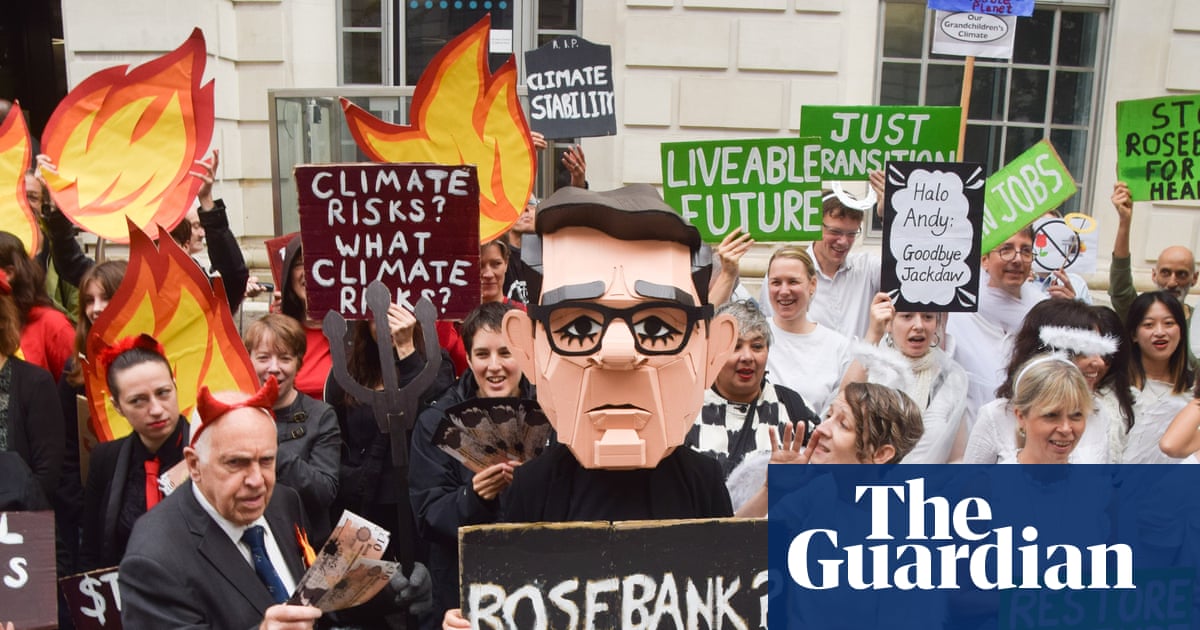
A protest against the Rosebank oilfield outside the Department for Energy Security and Net Zero last month. Photograph: Vuk Valcic/Zuma Press Wire/ShutterstockView image in fullscreenA protest against the Rosebank oilfield outside the Department for Energy Security and Net Zero last month. Photograph: Vuk Valcic/Zuma Press Wire/ShutterstockAnalysisClimate always comes second: are green issues slipping down Burnham’s agenda?Kiran Stacey and Sandra LavillePrime minister says he’s committed to meeting climate targets, but some believe his actions suggest otherwise
Labour expected to cut EV targets for car industry despite MPs’ climate concerns
Andy Burnham insists he is committed to the green transition, but his MPs worry that in decision after decision, he is showing that other priorities come first.
“Our changing climate is a major concern for many Britons, not least because we have just emerged from our hottest summer on record,” the prime minister wrote in the Guardian in September.
Since then, however, he has overseen a series of announcements that have dismayed green-focused Labour MPs.
First his energy secretary, Miatta Fahnbulleh, approved the Jackdaw gasfield. Then his chancellor, John Healey, announced a series of cuts to green schemes such as heat pump subsidies.
Now MPs are carefully watching two key decisions to be made in the coming weeks: whether he pushes Fahnbulleh to approve the larger Rosebank oilfield, and whether his ministers cut electric vehicle targets.
“I know the prime minister is committed to the green transition and meeting our climate targets, and he understands the seriousness of the climate crisis,” said Catherine Fookes, a Labour backbencher.
But she added: “The government has some incredibly difficult decisions to make in the coming months … I believe the ZEV [zero emissions vehicle] mandate should stay, and Rosebank should be rejected.”
Her colleague Andrew Lewin said: “We have a strong record on renewables, and lots of good work being led by DESNZ [the energy department]. Approving Rosebank would risk undermining our record. It is not worth it.”
Ami McCarthy, the head of politics at Greenpeace, said: “This government’s heart seems to be in the right place on climate, but there’s still a real danger of them sleepwalking into reversing the progress made so far.”
View image in fullscreenMiatta Fahnbulleh, the energy secretary, arrives in Downing Street for a cabinet meeting last month. Photograph: Wiktor Szymanowicz/ShutterstockThose close to the prime minister insist he understands the importance of tackling the climate crisis and believes it can help to bring down living costs in the future.
But, at the same time, he is trying to give voters financial “breathing space” this winter while also bolstering national security.
Some Labour MPs criticised Burnham in the summer for responding to wildfires by urging people not to use barbecues rather than talking about the climate emergency. But they have been more concerned by decisions he has taken since.
The decisions to approve Jackdaw and cut some of the energy department’s green schemes were based on national security concerns.
And by cutting more than £3bn from the energy department, Healey has been able to raise defence spending – something the former defence secretary has made one of his top priorities.
The cuts will come principally from the £15bn warm homes plan, which promised to roll out electrified energy via heat pumps, rooftop solar panels and batteries, and to cut energy waste via home insulation. Funding for hydrogen and carbon capture technologies has been cut by £700m.
The cuts to the boiler upgrade scheme in particular were met with dismay among environmental experts. Britain lags behind many European countries when it comes to electrifying its heating system.
Experts say the UK is now unlikely to meet its heat pump targets and may even miss its emissions reductions target in the next carbon budget.
Andrew Sissons, a director at the National Endowment for Science, Technology and the Arts, a research charity, said: “The chancellor made a backward step here. If you speak to any climate change expert they will say the biggest problem to tackle is home heating.
“We are way behind where we need to be. The most effective action to remove carbon emissions from homes is to replace gas boilers with heat pumps.
“The boiler upgrade scheme is the key mechanism for removing emissions from home heating, and cutting it sends a damaging signal to the heat pump industry.”
James Dyson, a senior researcher at the thinktank E3G, said: “Reliance on gas means the UK will remain vulnerable to economic shocks and military threats.”
Green campaigners were also disappointed by the budget decisions to allow hyperscale datacentres to build on-site fossil fuel power generation and not to increase the windfall tax on energy companies.
BP profits hit $8.5bn (£6.4bn) in the three months to September – an 18-year high – while Shell doubled its profits to $10.8bn.
Defenders of the prime minister and the chancellor deny the government has slowed its efforts to tackle the climate crisis.
They say the cuts to green schemes were originally agreed by Keir Starmer’s government, and that this government’s decision to cut VAT from electricity bills would incentivise consumers to move away from gas.
Ministers are also working on plans to remove more levies from electricity bills and to fund environmental schemes through taxation instead, something green campaigners are likely to welcome.
Danny Gross, a climate campaigner at Friends of the Earth, said: “While the chancellor stopped new levies being piled on to energy bills, he failed to remove the remaining ones that keep electricity so expensive. These should be moved to general taxation to share costs more fairly.”
For nervous Labour MPs, the decisions over Rosebank and the ZEV mandate are key.
While Fahnbulleh’s allies say she wants to block the oilfield, those close to Healey say he wants it to go ahead.
Burnham is reported to have sided with the chancellor, but No 10 officials insist the PM is happy for Fahnbulleh to make her own decision. The final outcome is due before the end of the year.
More immediately, ministers will meet this week to finalise the 2030 EV target, which the Guardian understands will be cut by about a quarter.
Again, those close to the PM say the decision reflects business reality, and has not been his to make after he recused himself because of his wife’s role at an EV charging company.
But for some in his party, it is another sign that when key judgment calls are being made, the climate is coming second every time.
One MP said: “I think Andy cares about the climate, but if every decision he makes ends up damaging it, his intentions don’t really matter.”
Fox Style News Syndicate. Sourced from broadcast reporting: Read Full Source Coverage.