
If your document appears in a search results page, the contents of the <title> element may appear as the title link for the search result (if you’re unfamiliar with the different parts of a Google Search result, you might want to check out the anatomy of a search result video).
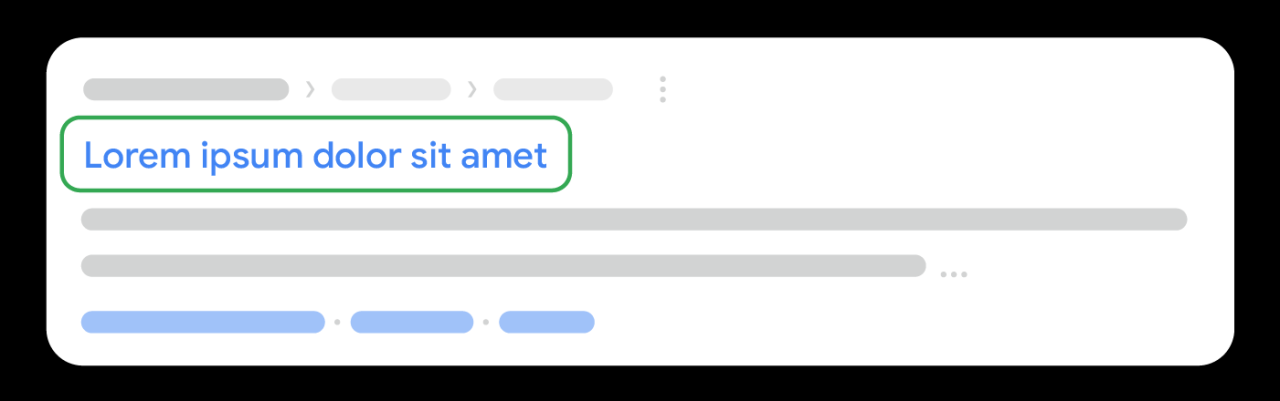
The <title> element for your homepage can list the name of your website or business, and could include other bits of important information like the physical location of the business or maybe a few of its main focuses or offerings.
Accurately describe the page’s content
Choose title text that reads naturally and effectively communicates the topic of the page’s content.
Avoid:
- Using text in the
<title>element that has no relation to the content on the page. - Using default or vague text like “Untitled” or “New Page 1”.
Create unique <title> elements for each page
Make sure each page on your site has unique text in the <title> element, which helps Google know how the page is distinct from the others on your site. If your site uses separate mobile pages, remember to use descriptive text in the <title> elements on the mobile versions too.
Avoid:
- Using a single title in all
<title>elements across your site’s pages or a large group of pages.
Use brief,<title> elements
<title> elements can be both short and informative. If the text in the <title> element is too long or otherwise deemed less relevant, Google may show only a portion of the text in your <title> element, or a title link that’s automatically generated in the search result.
Avoid:
- Using extremely lengthy text in
<title>elements that are unhelpful to users. - Stuffing unneeded keywords in your
<title>element.

Comments (0)