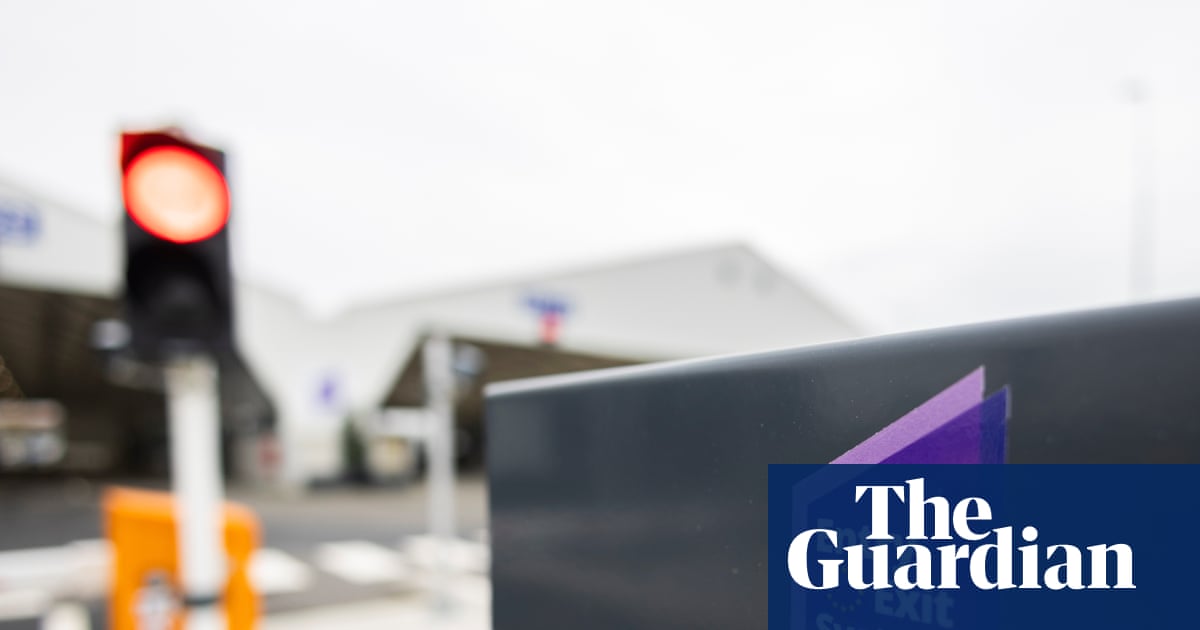
The entry and exit system was supposed to be active across the EU by September, but is not yet fully deployed. Photograph: Graeme Robertson/The GuardianView image in fullscreenThe entry and exit system was supposed to be active across the EU by September, but is not yet fully deployed. Photograph: Graeme Robertson/The GuardianUK-EU breakthrough will allow airport-style checks at Eurotunnel to avoid border ‘chaos’ Eurotunnel owner Getlink wants to replicate ‘airport experience’ at Folkestone and Calais, without making people get out of cars
Airport-style passport and fingerprinting controls are to be introduced at Eurotunnel in an attempt to prevent “short-term and long-term chaos” in Folkestone and Calais.
In a breakthrough for travellers, the European Commission has agreed to a new system in which an “eagle eye” camera system, already used in Rome and Paris airports to supervise fingerprinting and facial imaging, will be used at the border between the UK and France.
Yann Leriche, the chief executive of Getlink, the Eurotunnel owner, said it had tried to replicate the “airport experience” but wanted to go much further.
Instead of getting out of the car and getting biometrics taken at a terminal building, holidaymakers and business travellers will now be greeted with special drive-through terminals in Folkestone and Calais.
View image in fullscreenNew airport style drive-in biometrics kiosks at Eurotunnel in Calais. Photograph: Graeme Robertson/The GuardianBoth sides are now equipped with 120 kiosks under the case of an eagle-eye camera that will be monitored by police, similar to e-gates at airports where police are not physically present at each gate.
In the coming weeks, Leriche will meet UK and French authorities presenting a 40-page proposal to allow Eurotunnel to become a “laboratory” for an “intelligent border” using emerging tech and lessons learned from the US and Singapore.
The entry and exit system (EES) requires all third-country citizens including British passport holders to submit fingerprints and facial images as they enter and exit the Schengen area, but has been delayed for years.
EES was supposed to be active across the EU by 9 September, but nine of the 27 EU member states, including France, have yet to be deploy it fully because of continued technical issues.
View image in fullscreenThe new drive-in fingerprinting terminals at Eurotunnel. Photograph: Graeme Robertson/The GuardianIt has always been a logistical nightmare for Eurotunnel and a potential cause of miles-long tailbacks at the approach to the terminal.
Originally, Getlink had planned to use a tablet to hand to the passengers in their cars to allow them to self-fingerprint and capture a facial image. It also looked at a system involving passengers parking up and going into the terminal to get fingerprinting.
But both models would have required the physical presence of police officers for first-time fingerprinting.
Leriche said: “We told the authorities: it is going to be a mess. Many people are going to the wrong place and you can’t have police jumping from one place to the next to solve the issues. It would also means customers would have a bad experience, particularly at peak time.
“This is not something people in airports experience, but nobody approached this before, thinking we could have an airport experience at the border here. But we said: why not?”
View image in fullscreenYann Leriche, the chief executive of Getlink. Photograph: Graeme Robertson/The GuardianHe said that after “many, many discussions” with the European Commission and the French authorities, finally they were “authorised” to trial “eagle-eye cameras” at each kiosk. “The French authorities are also on board because for them it is more efficient, too, so we are all aligned on the trial,” he said.
The trial will last two years, but Eurotunnel hopes the experiment will become permanent.
Each car will be able to pull up to an individual kiosk, with two stands per vehicle to read passports and take fingerprints and facial images. “It will prevent the chaos in the long term and the short term and if the experiment works, as hopefully it will, then it will become permanent,” said Leriche.
He said the company had been inspired by visits to the US/Mexico border controls, where drivers and passengers remain in their cars.
View image in fullscreenThe new drive-in border controls at Eurotunnel. Photograph: Graeme Robertson/The GuardianThe requirement of having a police officer present each time a first-time passenger, or “primo” as they are known, submits their fingerprints was designed as a safeguard against subterfuge. Criminals, for example, could use a fellow passenger for example with a “clean skin” fingerprint.
Leriche said he had no idea when the system will be introduced by France. “It has been delayed and delayed and delayed, but our kiosks are there, they are can function but the connection with the French system is still not working. It is a question was are asking all the time.”
This week it emerged that the EU had filed a lawsuit against IBM and two other companies involved in the implementation of EES.
Fox Style News Syndicate. Sourced from broadcast reporting: Read Full Source Coverage.